
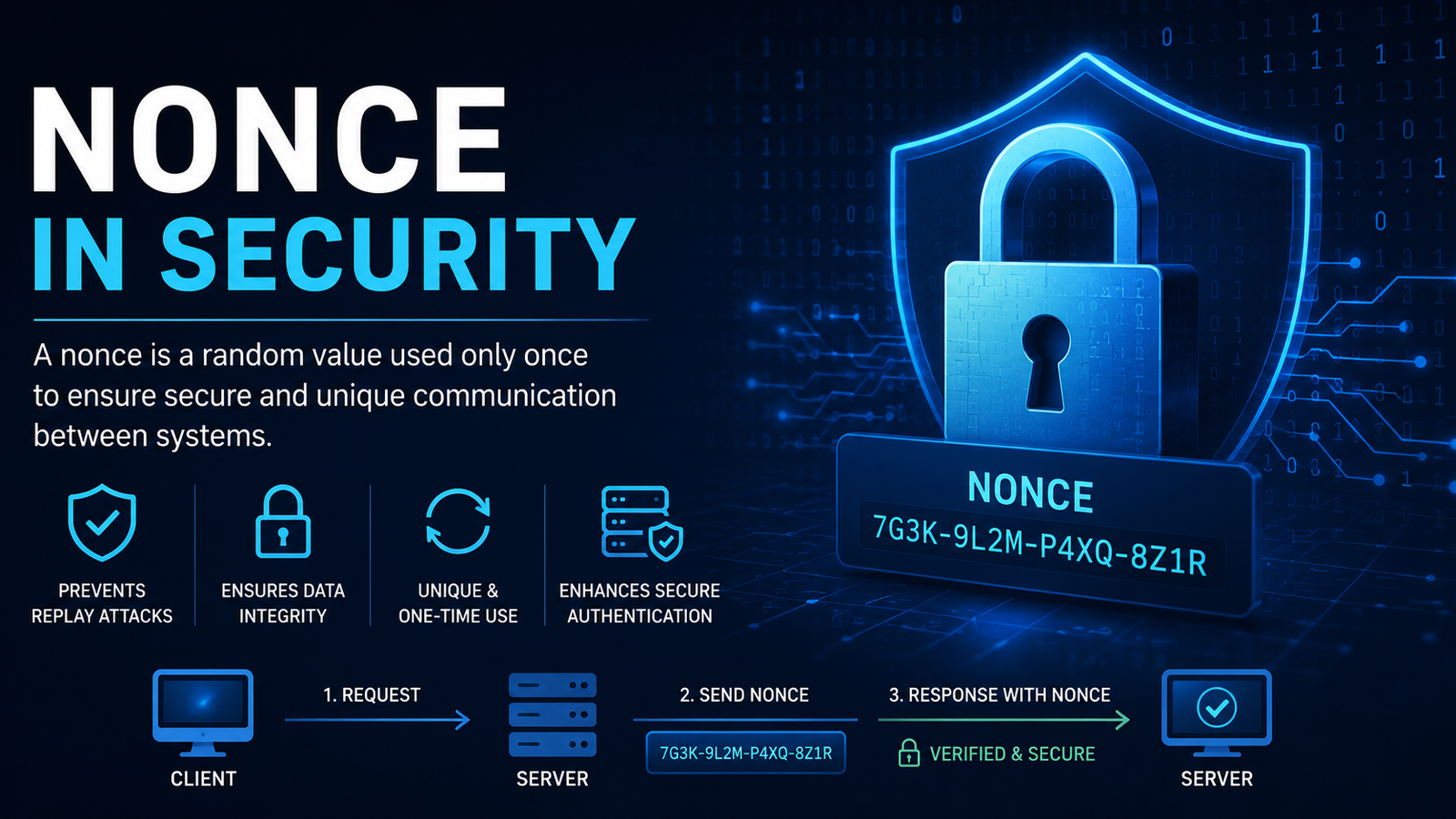
A nonce in security is one of the most important concepts in modern cybersecurity. Although the term may sound technical, it plays a vital role in protecting online communications, financial transactions, authentication systems, and cryptographic protocols. A nonce is a randomly generated number or value that is used only once during a specific communication or transaction. Because it is unique and temporary, it helps prevent attackers from reusing intercepted data to gain unauthorized access.
As cyber threats continue to evolve, organizations rely on strong cryptographic techniques to secure sensitive information. Nonces are widely used in encryption, authentication, blockchain technology, digital signatures, and secure network communications. Their primary purpose is to ensure that every transaction or request is unique, making replay attacks and data manipulation significantly more difficult.
Understanding nonce in security is essential for developers, cybersecurity professionals, and businesses that want to build secure applications and protect user data.
What Is a Nonce in Security?
The word “nonce” stands for “number used once.” In cybersecurity, it refers to a unique random value generated for a single authentication session, encryption process, or communication request.
Unlike passwords or encryption keys, a nonce is not meant to remain secret forever. Instead, its value comes from being unique and used only once. Even if an attacker intercepts a nonce, it cannot be reused successfully because the receiving system expects a new value for every request.
This simple concept provides a powerful defense against several common cyberattacks.
Why Nonce in Security Is Important
Modern communication systems exchange massive amounts of sensitive information every day. Online banking, eCommerce websites, messaging applications, and cloud services all require secure authentication and encrypted communication.
Without a nonce, attackers could capture legitimate requests and replay them later to trick systems into repeating transactions or granting unauthorized access. By introducing a unique value into every session, systems can detect duplicate requests and reject them immediately.
This additional verification layer significantly improves the integrity, confidentiality, and authenticity of digital communications.
How a Nonce Works
When a secure communication begins, one system generates a random nonce and sends it to the other party. The recipient combines this nonce with cryptographic algorithms, encryption keys, or digital signatures before responding.
Because each nonce is unique, every encrypted message becomes different even when the same information is transmitted multiple times. If someone attempts to resend an earlier message, the system identifies that the nonce has already been used and rejects the request.
This process ensures that each communication session remains fresh and resistant to replay attacks.
Nonce in Authentication Systems
Authentication protocols frequently rely on nonces to verify user identities securely. During login, the server generates a unique nonce and sends it to the client.
The client uses the nonce together with authentication credentials to create a secure response. Since the nonce changes with every login attempt, attackers cannot reuse previously intercepted authentication messages.
This mechanism is commonly used in challenge-response authentication systems, where proving knowledge of a secret is more important than transmitting the secret itself.
Using nonce in security greatly strengthens user authentication while reducing the risk of credential theft.
Nonce in Encryption
Encryption algorithms often incorporate nonces to ensure that identical messages produce completely different encrypted outputs.
Without a nonce, encrypting the same message with the same key could generate identical ciphertext every time. This consistency would provide attackers with useful information about communication patterns.
Adding a nonce introduces randomness into the encryption process, making encrypted messages unique even when their original content remains unchanged.
Modern encryption standards such as AES-GCM and ChaCha20-Poly1305 rely heavily on properly generated nonces to provide strong security guarantees.
Nonce in Blockchain Technology
Blockchain networks extensively use nonces during cryptocurrency mining and transaction validation.
In proof-of-work systems, miners repeatedly adjust the nonce while calculating cryptographic hashes. Their goal is to discover a hash value that satisfies the network’s required difficulty level.
Every change to the nonce generates an entirely different hash result. This process continues until a valid solution is found.
Beyond mining, blockchain protocols also use nonces to prevent duplicate transactions and ensure that every transaction remains unique within the network.
Preventing Replay Attacks
One of the primary benefits of nonce in security is protection against replay attacks.
A replay attack occurs when a cybercriminal intercepts a valid communication and later retransmits it to obtain unauthorized access or repeat a financial transaction.
For example, if an attacker captures an online payment request and successfully resends it, the payment could be processed multiple times.
Systems that use unique nonces immediately recognize previously used values and reject duplicate requests. As a result, intercepted communications cannot simply be replayed to achieve malicious objectives.
This protection makes nonces an essential component of secure online services.
Best Practices for Using Nonces
Generating high-quality random values is critical when implementing nonces. Predictable or repeated nonces significantly weaken security and may expose encrypted communications to attack.
Developers should use cryptographically secure random number generators instead of standard random functions. Every nonce must be unique within its intended context.
Applications should also validate incoming nonces and maintain mechanisms that prevent duplicate usage during active sessions.
Proper nonce management becomes especially important in distributed systems where multiple servers process requests simultaneously.
Following these best practices ensures that nonces provide the intended level of protection.
Common Mistakes When Implementing Nonces
Although the concept appears simple, incorrect implementation can introduce serious vulnerabilities.
One common mistake is reusing the same nonce with the same encryption key. In many encryption algorithms, nonce reuse can completely compromise confidentiality.
Another mistake involves generating predictable nonces using weak random number generators. Attackers who can predict future nonce values may exploit this information to bypass security protections.
Some systems also fail to verify whether nonces have already been used, reducing their effectiveness against replay attacks.
Careful implementation and regular security testing help prevent these issues.
Real-World Applications of Nonce in Security
Nonces are widely used across modern technology. Secure web communications rely on them during HTTPS sessions and Transport Layer Security (TLS) protocols.
Mobile banking applications use nonces to secure payment requests and authentication sessions. Cloud service providers implement them to protect APIs from replay attacks.
Digital signatures incorporate nonces to guarantee message uniqueness, while OAuth authentication protocols depend on nonces to defend against cross-site request forgery and unauthorized login attempts.
Cryptocurrency platforms, online payment gateways, enterprise authentication systems, and encrypted messaging applications all benefit from properly implemented nonces.
These practical applications demonstrate why nonces remain fundamental to modern cybersecurity.
Future of Nonce in Security
As cybersecurity threats continue evolving, the importance of nonce-based protection will only increase. Artificial intelligence, cloud computing, Internet of Things devices, and decentralized applications all require secure communication mechanisms capable of preventing sophisticated attacks.
Future authentication protocols will likely combine nonces with biometric verification, behavioral analytics, and zero-trust security architectures to strengthen digital identity protection.
Advances in cryptography may introduce even more efficient methods for generating and managing nonces while maintaining strong security guarantees.
Regardless of technological changes, the principle of using unique, one-time values will remain central to secure communications.
Conclusion
Understanding nonce in security is essential for anyone involved in cybersecurity, software development, or digital infrastructure. A nonce is a simple yet powerful cryptographic mechanism that ensures each communication, transaction, or authentication request remains unique.
By preventing replay attacks, strengthening encryption, securing authentication systems, and supporting blockchain technologies, nonces provide an important layer of protection across countless digital services.
As cyber threats become increasingly sophisticated, organizations must continue implementing strong cryptographic practices that include properly generated and managed nonces. Combined with secure encryption, multi-factor authentication, regular software updates, and continuous monitoring, nonce-based protection helps create safer online environments for businesses and users alike.